Chapter 2: Have You Tried Calling the Police?
One day before the midnight visit, campaign signs were already causing trouble at Cupertino City Hall.
The setting was the September 1 City Council meeting.
Mayor Kitty Moore, who is White, and Vice Mayor Liang Chao, who is Chinese American, were discussing complaints about political signs appearing on private property without the homeowners’ permission.

This is the kind of issue that sounds comically small until seven campaign signs appear in your front yard and your neighbors begin wondering whether you have suddenly joined a political movement.
Some residents had been pulling the signs out.
Then they came back.
Others were reluctant to touch them.
Some did not know whether the signs belonged to a campaign, the City, a political organization, or a mysterious civic gardening program.
Vice Mayor Chao suggested adding a reporting mechanism to Cupertino’s 311 system so residents could ask the City for help with unwanted political signs.
From Mayor Moore’s perspective, according to the account in the draft, the solution seemed more direct.
Why not call the police?
On paper, this makes perfect sense.
Unauthorized person enters property.
Unauthorized object appears.
Homeowner calls law enforcement.
Problem solved.
A four-step flowchart. Very efficient.
But several Asian residents saw the workflow differently.
For many immigrants, calling the police over seven pieces of plastic felt less like civic efficiency and more like launching a cruise missile at a mosquito.
One resident explained the concern this way.
Maybe a neighbor had simply become overenthusiastic.
Maybe there had been a misunderstanding.
Everybody still had to live on the same block afterward.
Why turn a small neighborhood irritation into a police matter?
Another resident had repeatedly removed signs, only to find more of them appearing later.
According to the account in the draft, someone challenged the homeowner for taking down a sign and invoked the fact that one of the names on it belonged to a sitting councilmember.
To someone steeped in American campaign culture, this might sound ridiculous.
To an immigrant who wants a quiet life, it can sound like a warning.
City Council.
Politics.
Police.
Neighbors.
Election season.
Perhaps the easiest strategy was to wait until November and hope the signs disappeared along with the campaign mailers.
A third concern was even more revealing.
Some residents saw the words “Cupertino City” on signs or political material and wondered whether the signs had something to do with the government itself.
People who have lived in the United States their whole lives may find that confusion surprising.
People who immigrated from countries where government, political parties, and political power are much less clearly separated may understand it immediately.
Nobody hands new immigrants a 400-page orientation manual titled American Local Politics: Please Relax, the Yard Sign Is Privately Funded.
So residents improvised.
Some ignored the signs.
Some removed them quietly.
Some endured them.
Hardly anybody called the police.
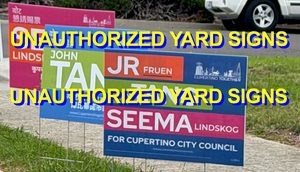
This is where the story loops back to our homeowner from Chapter 1.
Beginning in August, according to the family’s account, political signs repeatedly appeared without permission on an Asian homeowner’s Cupertino property.
The house sits along two busy roads, which apparently made it an excellent location for campaigns and a terrible location for anyone hoping to maintain control of the landscaping.
On some days, more than ten signs appeared.
The family removed them.
More appeared.
They removed those.
More came back.
At some point the family trash cans began functioning as an unofficial Cupertino election archive.
Still, they did not call police.
Friends occasionally helped remove and dispose of the signs. Some of those signs eventually ended up at the Santa Clara home featured in Chapter 1. No Script for Cupertino
Which gives us the first great civic mystery of the story.
The Asian homeowners whose property kept filling up with unwanted signs did not call the police.
So who did?
Richard Lowenthal did.
The White former mayor had put AirTags in signs because he believed people were stealing them.
And his call eventually resulted in Sheriff’s deputies arriving at the Chinese homeowner’s residence late at night.
There is an irony here worth appreciating.
At the City Council meeting, the question had effectively been:
Why are these residents so hesitant to involve police over campaign signs?
Less than twenty-four hours later, one Chinese immigrant family got a practical demonstration of exactly why some immigrants might hesitate.
No PowerPoint presentation could have made the point more efficiently.
This story is still on-going. Stay tuned to No Script for Cupertino.
This is what’s happening in Cupertino. Our story has no script.