By now, the residents had learned an important lesson about public records. The first request could be denied. The second request could also be denied. So naturally, they submitted a third. This was Silicon Valley. When version 1.0 fails, you ship 2.0. When 2.0 fails, you add more logging, rename the project, and try again.
The third request had one advantage the others did not. It came from the homeowner himself, the man whose house had been visited late at night by multiple Sheriff’s deputies. His address. His front yard. His doorbell. His backyard. Whatever investigation existed had quite literally arrived at his doorstep.
Surely that would unlock something.
Denied.
The Sheriff’s Office said the matter was still under investigation, so the requested information could not be disclosed. The homeowner read the response twice. An investigation. Interesting. He had been asleep when deputies arrived, opened the door, cooperated with them, and watched the whole thing unfold at his own home. Yet weeks later, the government apparently knew enough about the incident to keep investigating it while telling him almost nothing about what the investigation involved.
There was another puzzle. Residents still had trouble locating the kind of clear incident report or case information they expected after a late-night response involving several deputies. Somehow the system had reached an impressive equilibrium: the investigation was serious enough to justify withholding information, while the homeowner at the center of it could not learn much about it.
All over some campaign signs.
Somewhere in Silicon Valley, an engineer would have marked the ticket WORKING AS DESIGNED and immediately start working on another ticket.
Then Someone Checked the Money
While the records requests went nowhere, more people joined the effort. Cupertino has a predictable response when a mystery survives longer than a few days. Somebody creates a spreadsheet.
One resident searched campaign filings. Another looked through nonprofit disclosures. Someone else searched old news stories. Browser tabs multiplied. Shared Google folders appeared. Screenshots acquired filenames. Links flew through group chats at speeds normally reserved for school rankings and restaurant recommendations.
Then a new data point appeared.
San José Spotlight’s public donor disclosure lists Richard Lowenthal in its $10,000 to $24,999 donor category. San José Spotlight Public reporting also showed that Lowenthal contributed $5,000 to former Cupertino Mayor Rod Sinks’ 2024 City Council campaign. San José Spotlight The residents’ review of Cupertino campaign-finance records also led them to Lowenthal’s financial support for candidates involved in the 2026 election, including J.R. Fruen, Seema Lindskog, and John Tang.
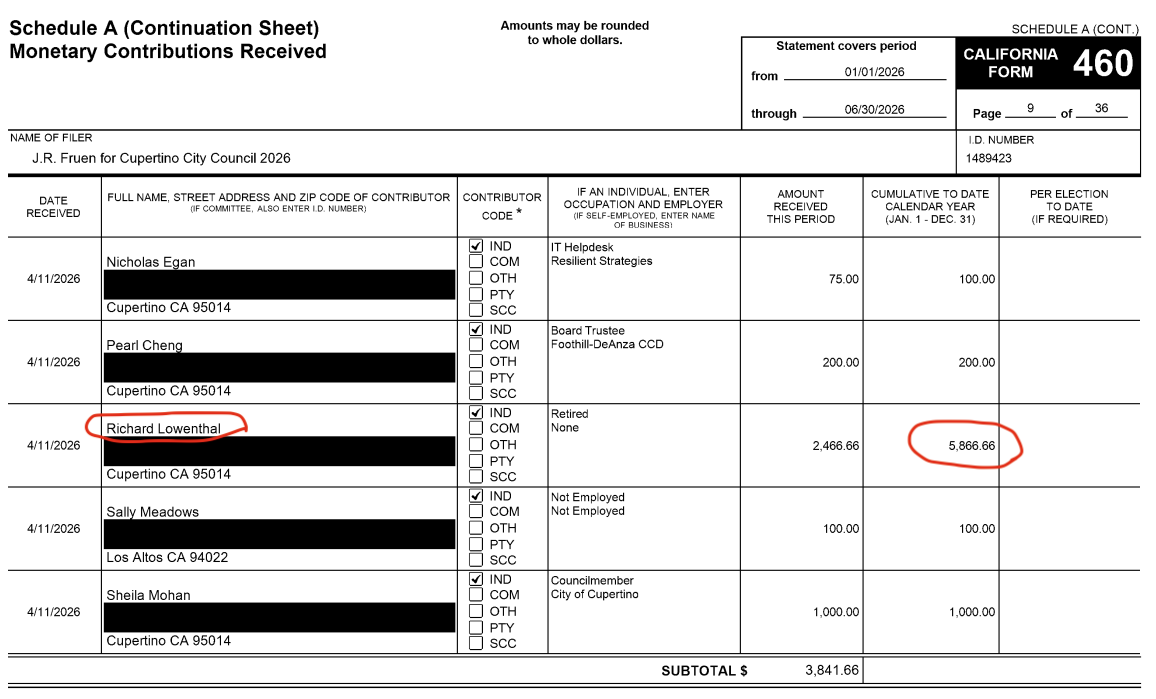
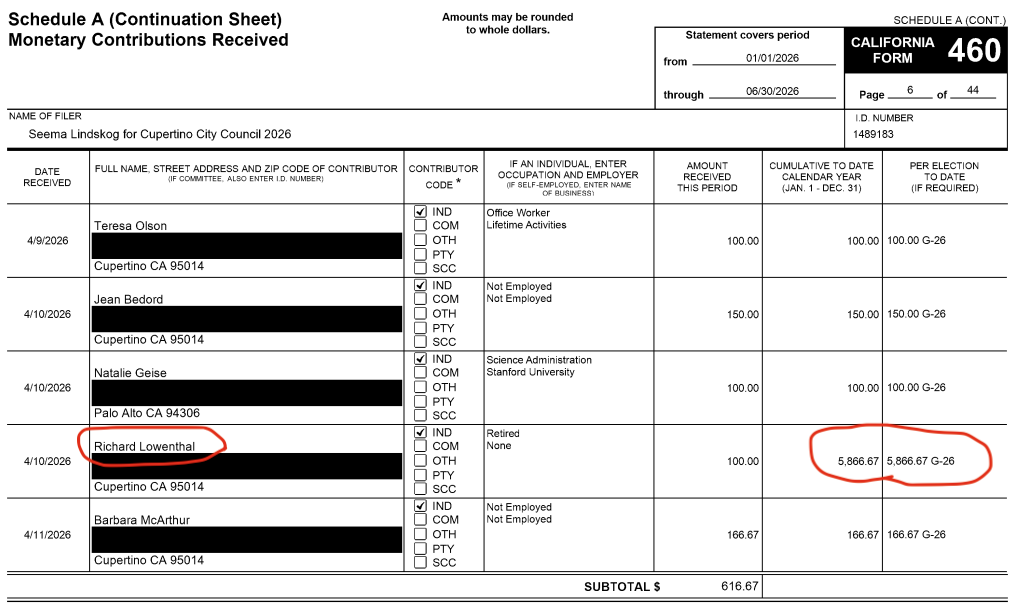
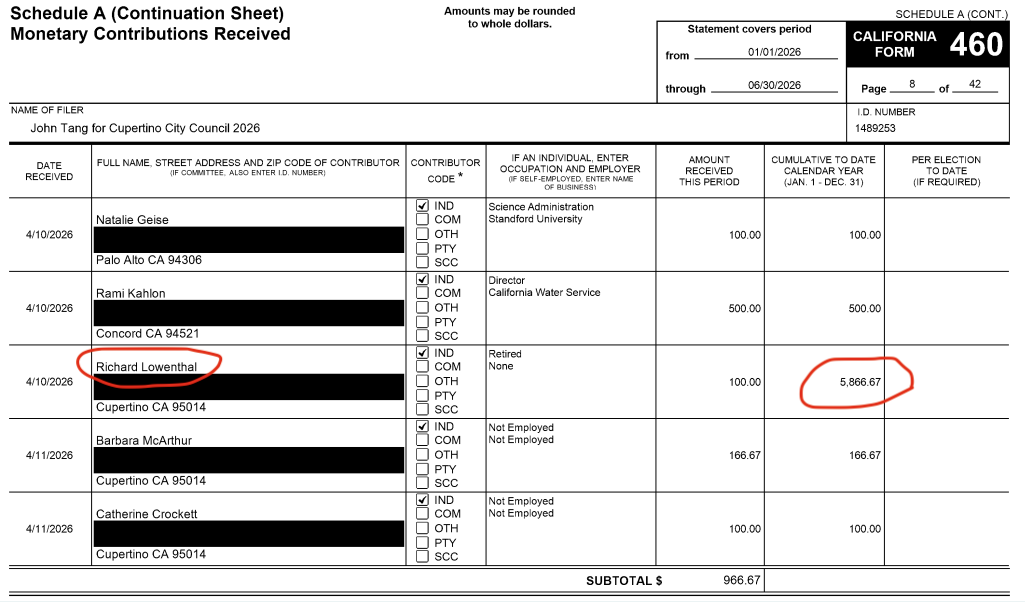
This proved exactly one thing: Richard Lowenthal participated financially in local civic and political life.
Political contributions are legal. Donations to nonprofit journalism are legal. Supporting candidates is legal. America has constructed an elaborate disclosure system around precisely this idea: people can give money to causes and candidates, and everyone else gets to look at the filings and draw their own questions.
The spreadsheet therefore gained another column.
Lowenthal was already a White former mayor, an active political figure, a supporter of candidates in the current election, and the person whose complaint preceded the late-night Sheriff’s response. Now residents were also looking at publicly disclosed financial relationships involving local campaigns and the news organization covering the controversy.
A spreadsheet cannot prove influence. It can make relationships considerably easier to see.
And Cupertino people have great respect for a properly labeled spreadsheet.
Then Someone Looked at the Map
At some point, somebody stopped staring at contribution records and returned to the simplest piece of evidence available.
The address.
The house where the deputies had appeared was not in Cupertino. It was in Santa Clara.
Three miles is almost nothing in Silicon Valley. It might be a coffee run, half a commute, or the distance somebody drives to save twelve cents a gallon at Costco. Administratively, however, three miles can place you in another universe.
Cupertino contracts with the Santa Clara County Sheriff’s Office for law-enforcement services. The Sheriff’s West Valley Division provides policing for Cupertino, along with Saratoga, Los Altos Hills, and parts of unincorporated western Santa Clara County. Santa Clara has its own police department, and its Police Department maintains its own calls-for-service and public-records system.
This meant the September 2 incident had crossed a government boundary. If Lowenthal followed his AirTag into the City of Santa Clara and called 911 there, the residents wondered what the Santa Clara Police Department knew.
Suddenly the story looked less like a neighborhood dispute and more like a distributed systems problem. Two jurisdictions. Two law-enforcement agencies. One set of yard signs. Anyone who has worked in software knows what comes next.
Each system has its own logs.
A Different City, a Different API
The Santa Clara homeowner wrote to the Santa Clara City Council. He explained what had happened at his house, described his difficulty understanding the Sheriff’s response, and asked for help.
Then something unexpected happened.
Someone answered quickly.
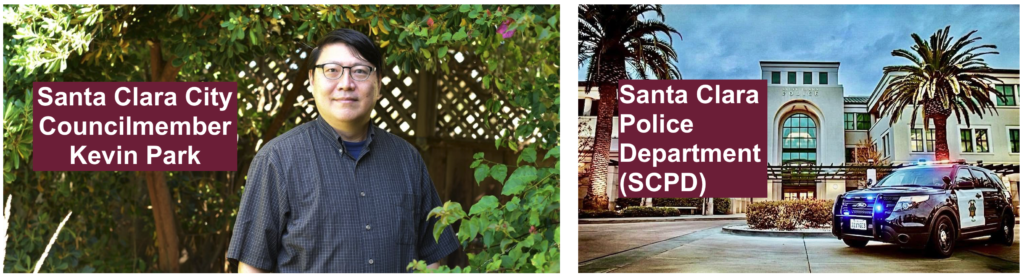
Santa Clara Councilmember Kevin Park, who has an engineering background, responded and helped connect the homeowner with the local police department. According to the homeowner’s account, the process then moved with startling efficiency. He sent an email, Park responded, the police department checked its records, and information from the September 2 call arrived within hours.
The residents had become accustomed to a different workflow: send request, wait, follow up, wait again, submit CPRA request, receive denial, revise PDF, send another request, and eventually create a folder called Final_Final_v3_USE_THIS_ONE.
Santa Clara appeared to be running different software.
According to the homeowner, the entire sequence from asking the City Council for assistance to receiving the SCPD records took less than one business day. Santa Clara’s Police Department publicly states that calls-for-service and other police records can be requested through its records system.
The contrast was difficult to miss. Repeated efforts involving the Sheriff’s Office had produced denials and the explanation that the matter remained under investigation. A request involving Santa Clara produced records within hours.
Same evening. Same house. Same signs.
Very different user experience.
Silicon Valley companies spend millions mapping the customer journey. Here was a case study available for free.
Then They Opened the Records
The residents expected the Santa Clara records to confirm what they already knew.
They did something more useful.
They changed the timeline.
According to the records obtained by the homeowner and summarized in the group’s materials, Santa Clara Police had been involved earlier that night. At approximately 10:35 p.m., SCPD handled a call connected to the sign dispute as a civil standby. The Sheriff’s Office was contacted later, and multiple Sheriff’s personnel subsequently appeared at the homeowner’s residence. Summary
That sequence created a new problem to debug.
Until then, the residents had mostly been asking why multiple Sheriff’s deputies had appeared at a Chinese homeowner’s house late at night over campaign signs. Now they wanted to know why two law-enforcement agencies appeared to have approached the same underlying dispute so differently.
There could be perfectly ordinary reasons. Different callers can give different information. A situation can change. Dispatchers make decisions based on what they hear at a particular moment. The AirTag might have affected the assessment. Jurisdiction might have mattered. Something said during the later call might have changed the perceived urgency.
The residents wanted to know what changed.
That was the whole point.
One agency’s records had finally given them the first set of logs.
Debug Mode
The documents went onto the table. Times were compared. Agencies were compared. Public statements were compared with police records. People went back through the security footage and tried to reconstruct the evening minute by minute.
For weeks, the central question had been why the Sheriff’s Office would not release information about the midnight response. The Santa Clara records shifted the focus. Now the most interesting part of the story seemed to sit in the gap between the two law-enforcement contacts.
What exactly had been reported to Santa Clara Police? What happened after SCPD became involved? Why was the Sheriff’s Office contacted afterward? What information did Sheriff’s dispatch receive? What caused a matter handled earlier as a civil standby to be followed later by multiple Sheriff’s personnel appearing at the house?
Then there was the records question itself. Why could the homeowner obtain information about the first police response within hours while remaining largely in the dark about the second response at his own home?
These questions might eventually have routine answers. Different agencies have different procedures, different exemptions can apply to different records, and an active investigation can affect disclosure. The residents were not looking for a conspiracy to fill every blank space. They wanted the blank spaces filled with facts.
This is one advantage of logs.
People remember differently. People argue about motives. People tell stories.
Logs timestamp.
The group had started with what looked like a simple bug: campaign signs kept appearing on private property.
Then they turned on debug mode.
Now the ticket involved two law-enforcement agencies, two cities, multiple public-records requests, campaign-finance filings, an AirTag, a White former mayor, a news organization, several political campaigns, and an investigation whose records remained unavailable.
Any software engineer could recognize the situation.
The original story ticket had become an epic.
And for the first time, the residents had obtained enough data to see where the next question lived:
What happened between the first police response and the second?
The answer, if there was one, was somewhere in the logs they still did not have.
To be continued in No Script for Cupertino.
This is what’s happening in Cupertino. Our story has no script.